Community Development Master’s Thesis

The culmination of my graduate academic experience as part of the Community Development Graduate Group at the University of California, Davis (UC Davis) was my thesis entitled “EJLP: A Case Study of Relationship Building in a Community-University Partnership Program.”

This research was conducted in partnership with the Feminist Research Institute (FRI) at UC Davis, centering their Environmental Justice Leaders Program (EJLP). The EJLP is a program through the university that works to bring together professional, community-based environmental justice leaders into collaboration with university researchers at UC Davis. Environmental justice (EJ) leaders who take part in this program work within their communities across California to address EJ issues related to transportation and energy justice.

I worked with the EJLP beginning in the summer of 2023 as a graduate student research assistant. In this role, I began to learn how the program functioned, as well as the opportunities and challenges in running the program under different circumstances. Previously, the EJLP invited EJ Leaders with varying degrees of professional experience, from across the country to participate. Through collaborative processes at FRI, we established a new criteria for the EJLP cohort that could help improve upon the momentum of previous cohorts.

Through this thesis project, I interwove four bodies of theory including feminist, community-based participatory research, environmental justice, and design theories to make sense of the EJLP. My role was assisting in the program redesign and implementation. During this process, I conducted a formative, developmental evaluation leveraging methods of usability testing, a mid-program survey, and semi-structured interviews with UC Davis research partners working with the EJLP.

Findings suggested that the EJLP was successful in launching the eight partnerships in formation to the benefit of both EJ Leaders and their UC Davis research counterparts; however, results were preliminary and further evaluation is needed to determine the if partnerships were sustained and remained beneficial to both parties. Overall, the data from my research highlighted the value and importance of the EJLP and the steps the program, as well as others like it, can take to build better community-university partnerships that center the long-term needs of community leaders and their organizations.

STAKEHOLDER MAPPING BEST PRACTICES

Throughout the summer of 2023, I worked as a graduate student intern with Valley Vision (VV) in Sacramento. I was a part of their Community Economic Resilience Fund (CERF, now known as California Jobs First) team. VV is the regional convenor for the Capital Region, which includes the eight counties of Colusa, El Dorado, Nevada, Placer, Sacramento, Sutter, Yolo, and Yuba.

In collaboration with a fellow community development graduate student, we developed best practices for their stakeholder mapping process. Our team also created and analyzed results from a community partner survey that informed their stakeholder mapping process.

Presentation

ENVIRONMENTAL JUSTICE & ARTISTIC EXPRESSION IN CALIFORNIA’S SAN JOAQUIN VALLEY

My core passion lies at the intersection of the arts and social justice. During my first year of my graduate studies, I was privileged to take a course on critical environmental justice of the Central Valley taught by Jonathan London. The culmination of my work in this class was a book proposal and presentation entitled Environmental Justice & Artistic Expression in California’s San Joaquin Valley.

My research details the history of the valley from pre-settler colonial times through westward expansion, the Great Depression, and the United Farm Workers movement. The book proposal is broken into four parts:

  • Part I – Set in Stone: Manifest Destiny & Indigenous Rebellion
  • Part II – The Stories We Tell: Settler Colonialism & Indigenous Resilience
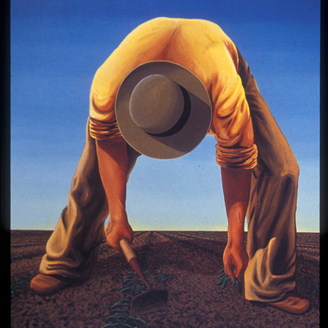
  • Part III – Pictures Worth a Thousand Words – Great Depression Era Photography of Worker Exploitation & Strength
  • Part IV – Art in the Age of Revolution – Chicanx Artistic Expression & Farm Worker Protest in the San Joaquin Valley

Presentation

Book Proposal

HEALING GROUNDS

Healing Grounds is a neighborhood design project co-created in collaboration with a team of graduate students through our course – Urban Planning and Design – at UC Davis. This site is located in what is currently PG&E property in East Davis, at the intersection of L St and 5th St.

This proposed project emphasizes the need for affordable, sustainably designed housing for the City of Davis. Units are structured around the model of co-housing, and the built environment encourages on-site energy generation, food production, and shared bike and vehicle transportation.

Project Proposal

YOUR MONEY OR YOUR LIFE: FINANCIAL LITERACY & CONSUMER ADVOCACY COURSE PROPOSAL

Through my involvement in Beyond the Classroom, a civic engagement and leadership program at the University of Maryland, College Park, I worked with a capstone team to create a proposal for a financial literacy and consumer advocacy course for students.

I led this research through survey design and implementation, and the drafting of the proposed syllabus template.

Presentation

Syllabus Template

*Below this PDF is a button to download a Word.doc copy that can be edited and utilized by instructors

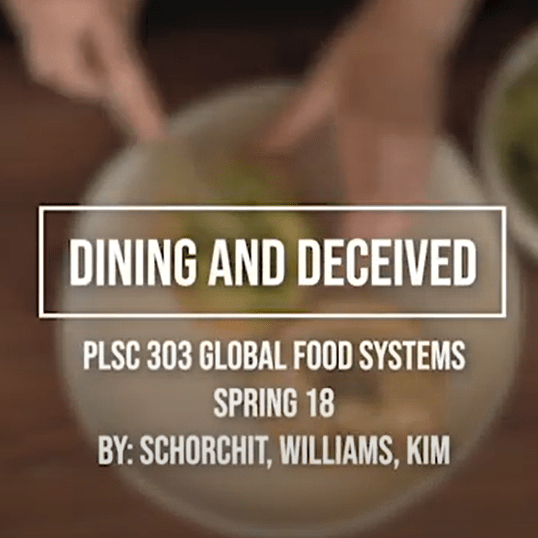
DINING & DECEIVED VIDEO PROJECT

Dining & Deceived is a group video project that my peers and I completed for our undergraduate course in Agroecology at University of Maryland, College Park. This video is intended to highlight the environmental impact of foods that we eat, and provide alternatives to the current system.

MONTGOMERY PARKS COMMUNITY GARDENS

Through my Environmental Science & Policy Capstone Project – Montgomery Parks Community Gardens, myself and a team of undergraduate students created a plan for the future of the community garden program overseen by the Department of Parks in Montgomery County, MD.

I developed a funding plan for the gardens and was instrumental in locating potential future garden. This project gave me the opportunity to explore the opportunities and challenges of private-public partnerships for local governance on issues related to food and agriculture.

Presentation